
Canvas Rendering
High-Performance 2D Canvas & WebGL Rendering Pipelines
Architecting hardware-accelerated graphical interfaces and offscreen canvas buffers for modern web applications.
Read Full ArticleArchitecting Cryptographic Trust, Automated Fund Locks, and Dispute Resolution Pipelines

In modern peer-to-peer commerce, digital graphic markups, service platforms, and software marketplaces, establishing financial trust between unverified buyers and independent service providers is a fundamental challenge. Traditional transaction models require upfront payment, exposing buyers to non-delivery risks, or post-service settlement, leaving developers and creative professionals vulnerable to unpaid invoices. Automated escrow verification systems bridge this vulnerability by acting as deterministic, programmatic intermediaries. Funds are securely locked in an isolated clearing account upon purchase initiation and are only disbursed across verified payout gateways when pre-negotiated cryptographic or state-based criteria are verified.
Building an industrial-grade escrow pipeline requires more than simple payment gateway integrations. Software engineers must account for transactional race conditions, state machine synchronizations, cryptographic webhooks, automated dispute timeouts, and split-payout routing algorithms. This deep dive explores the core architectural patterns necessary to build robust, scalable escrow verification engine pipelines for high-traffic web applications.
An escrow verification system functions as a strictly bounded finite state machine (FSM). To eliminate security loopholes, state transitions must be immutable and triggerable only through verifiable events such as cryptographic payment Webhooks, signed client approvals, or administrative dispute override decisions. Allowing direct, unvalidated state updates within client-side application bundles exposes platforms to client manipulation and unauthorized fund withdrawals.
High-security escrow pipelines adhere to three fundamental architectural pillars:
Managing the lifecycle of an escrow transaction requires preventing illegal state jumps. For instance, a transaction should never transition directly from `AWAITING_FUNDS` to `FUNDS_RELEASED` without first registering a verified `FUNDS_LOCKED` event. The table below outlines the primary states, required transition triggers, and safe failure strategies required within an enterprise escrow engine:
| State Name | Valid Pre-Condition | Trigger Mechanism | Fail-Safe Timeout Action |
|---|---|---|---|
| AWAITING_FUNDS | Order Created | Buyer generates payment checkout modal | Auto-cancel checkout session after 30 minutes |
| FUNDS_LOCKED | AWAITING_FUNDS | Cryptographic webhook signature verification | Flag for manual support review if webhook fails |
| WORK_SUBMITTED | FUNDS_LOCKED | Seller uploads digital deliverable asset/link | Notify buyer; start 72-hour review clock |
| DISPUTE_RAISED | WORK_SUBMITTED | Buyer or Seller explicitly requests arbitration | Freeze fund release timers; assign support ticket |
| FUNDS_RELEASED | WORK_SUBMITTED / DISPUTE_RAISED | Buyer approves work OR 72h timeout expires | Execute Paystack / Stripe transfer settlement API |
| REFUNDED | FUNDS_LOCKED / DISPUTE_RAISED | Seller approves cancellation OR Admin ruling | Reverse transaction funds to buyer wallet/card |
Below is a production-ready Node.js backend controller demonstrating secure HMAC signature verification, atomic state updates, and dynamic payout split operations for an escrow engine pipeline:
const crypto = require('crypto');
const db = require('./database-driver');
const payoutGateway = require('./payout-gateway-sdk');

class EscrowVerificationEngine {
    constructor(secretKey) {
        this.secretKey = secretKey;
    }

    /**
     * Verifies the authenticity of incoming payment webhooks via HMAC-SHA512
     */
    verifyWebhookSignature(rawPayload, signatureHeader) {
        const hash = crypto
            .createHmac('sha512', this.secretKey)
            .update(rawPayload)
            .digest('hex');

        return hash === signatureHeader;
    }

    /**
     * Executes atomic state transition to lock funds in escrow
     */
    async lockTransactionFunds(transactionId, paymentReference, amountPaid) {
        return await db.transaction(async (trx) => {
            const escrowRecord = await trx('escrow_orders')
                .where({ id: transactionId })
                .forUpdate()
                .first();

            if (!escrowRecord) {
                throw new Error("Escrow record not found.");
            }

            if (escrowRecord.status !== 'AWAITING_FUNDS') {
                throw new Error(`Invalid state transition from ${escrowRecord.status}`);
            }

            if (escrowRecord.expectedAmount > amountPaid) {
                throw new Error("Underpayment detected. Flagging transaction.");
            }

            // Transition state atomically to FUNDS_LOCKED
            await trx('escrow_orders').where({ id: transactionId }).update({
                status: 'FUNDS_LOCKED',
                paymentReference: paymentReference,
                lockedAt: new Date().toISOString(),
                updatedAt: new Date().toISOString()
            });

            return { success: true, status: 'FUNDS_LOCKED' };
        });
    }

    /**
     * Settles transaction funds by calculating marketplace commission splits
     */
    async releaseEscrowPayout(transactionId, clientApprovalToken) {
        const order = await db('escrow_orders').where({ id: transactionId }).first();

        if (order.status !== 'WORK_SUBMITTED' && order.status !== 'DISPUTE_RESOLVED') {
            throw new Error("Funds cannot be released from the current state.");
        }

        // Calculate platform split (e.g., 10% platform fee, 90% vendor payout)
        const platformCommission = order.expectedAmount * 0.10;
        const vendorNetPayout = order.expectedAmount - platformCommission;

        // Dispatch transfer via payment aggregator API
        const payoutResponse = await payoutGateway.initiateTransfer({
            recipientCode: order.vendorRecipientCode,
            amount: vendorNetPayout,
            reason: `Escrow release for Order #${order.id}`
        });

        if (payoutResponse.status === 'SUCCESS') {
            await db('escrow_orders').where({ id: transactionId }).update({
                status: 'FUNDS_RELEASED',
                releasedAt: new Date().toISOString(),
                payoutReference: payoutResponse.transferReference
            });
            return { status: 'SUCCESS', netPayout: vendorNetPayout };
        } else {
            throw new Error("Payout transfer failed at gateway level.");
        }
    }
}

module.exports = EscrowVerificationEngine;
A persistent vulnerability in escrow design is passive abandonment, where a buyer accepts deliverables but neglects to click the "Approve Release" button. Without automated verification workflows, seller capital remains frozen indefinitely. Systems solve this using sliding auto-release timers. When a seller submits a deliverable, an immutable 72-hour countdown timer initiates. If the buyer takes no action and files no dispute within this timeframe, the system's background queue runner automatically transitions the transaction state to `FUNDS_RELEASED` and executes vendor payout routines.
Conversely, if a dispute is raised within the window, the countdown timer immediately pauses. The order transitions to `DISPUTE_RAISED`, blocking all programmatic payouts. In this phase, escrow platforms require secure evidence collection protocols. Both parties can submit cryptographic asset hashes, chat histories, and revised project files into a locked audit vault. Independent platform arbitrators review this evidence log and execute a controlled full or partial refund override through the administrative escrow panel.
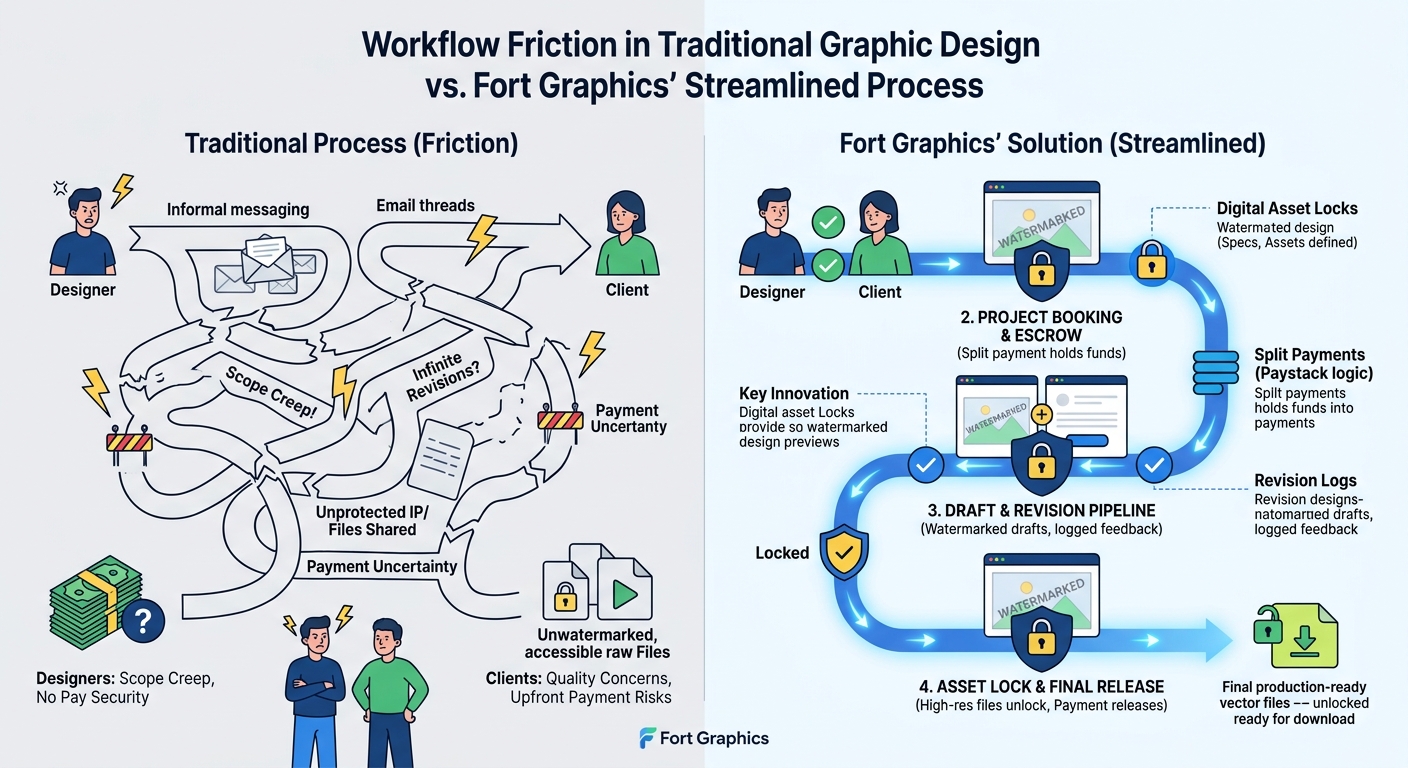
When dealing with digital assets like graphic designs, software source files, or proprietary schematics, escrow engines can be integrated with client-side file obfuscation and download locking mechanisms. In this configuration, vendor uploads are stored in protected object storage containers with AES-256 encryption. The buyer receives a watermarked or low-resolution web preview. The decryption key and un-watermarked high-resolution download URLs remain locked behind server-side access controllers. The server releases these asset keys only after the escrow state transitions to `FUNDS_RELEASED`, ensuring buyers cannot obtain production-ready files without completing the financial release loop.
Architecting hardware-accelerated graphical interfaces and offscreen canvas buffers for modern web applications.
Read Full ArticleExploring predictable state synchronization patterns and cloud databases across multi-user web environments.
Read Full Article